
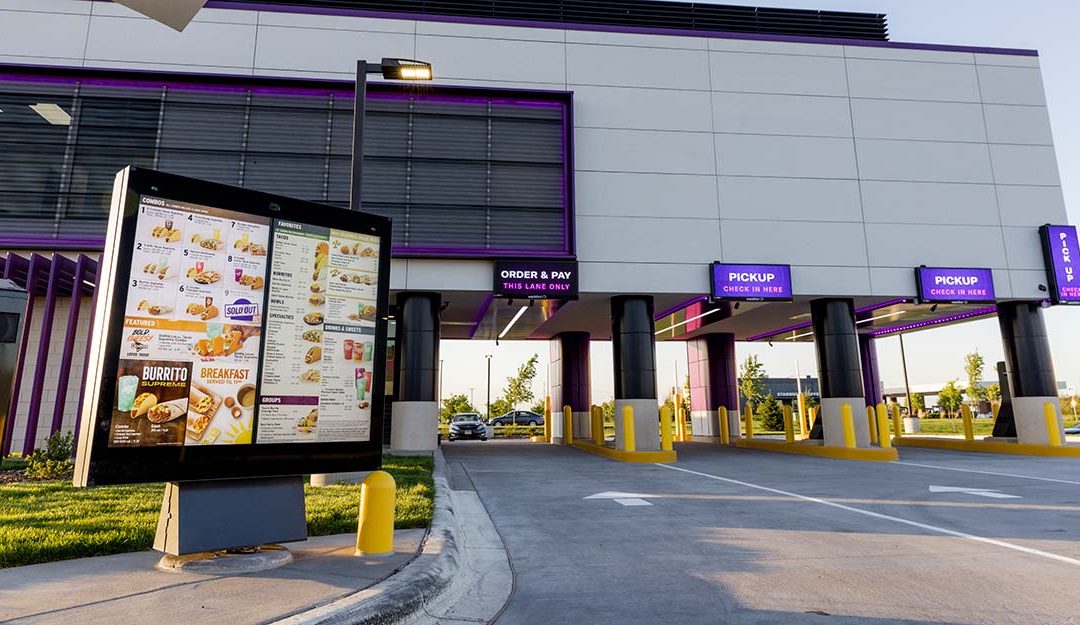
A two-story building in Brooklyn Park, Minnesota, is being studied by every serious QSR developer and net lease investor in the country. It has four drive-thru lanes, a kitchen on the second floor, and a proprietary vertical lift system that delivers food downward to waiting cars via what the brand calls a “food tube.” It targets service times of two minutes or less. It is called Taco Bell Defy, and it represents more than innovation; it signals the emergence of a new category of QSR real estate.
Understanding what this prototype means for the commercial real estate market is increasingly important for anyone who develops, leases, or invests in QSR assets.
Why Taco Bell Is Investing in Architecture
Taco Bell’s parent company, Yum! Brands, reported 7% U.S. system sales growth for Taco Bell, reaching $4 billion in Q2 2024. The Defy concept is not a novelty project. It is the architectural expression of a deliberate operational strategy: using physical design to increase throughput capacity beyond what a conventional single-lane configuration can achieve. The four dedicated lanes, which separate mobile orders, third-party delivery pickups, and on-site customers, allow the brand to serve multiple customer types simultaneously without queue congestion.
Taco Bell’s Go Mobile and Defy concepts were designed to rely on digital features by operating as drive-thru-only locations. As of mid-2024, voice AI ordering technology had been deployed to over 100 Taco Bell locations across 13 states, with plans to reach hundreds more by year-end. Yum! launched its Byte by Yum! Platform, a unified, AI-powered restaurant technology system that covers point-of-sale, inventory, and loyalty, unifying every digital touchpoint across the brand.
What Multi-Lane Architecture Means for Real Estate
The Defy prototype requires a fundamentally different site than a traditional QSR pad. A larger land parcel is needed, typically 0.75 to 1.25 acres, compared with the 0.5 to 0.75 acres of a conventional fast-food building. Ingress and egress configurations must accommodate multiple simultaneous lane entries and exits without causing street-level congestion. Building height and structural complexity are significantly greater, increasing construction cost per square foot.
All of these factors translate into longer lease commitments. When a franchisee or corporate operator invests in a two-story, multi-lane building with embedded technology infrastructure, lease terms extend accordingly. Longer leases mean greater income certainty for landlords, a more stable net present value for investors, and more competitive cap rate pricing at acquisition or disposition.
For developers, the Defy format offers both an opportunity and a planning challenge. Land requirements are larger, but the resulting property’s income-generating potential per square foot is significantly higher. Sites that can accommodate a Defy-style configuration, hard corners with strong ingress, 20,000+ vehicles per day, and space for four independent lane approaches are forming a distinct submarket within QSR real estate.
The Institutional Signal
When brands invest heavily in physical formats, it signals a long-term commitment to the brick-and-mortar channel. Taco Bell is not building two-story drive-thru prototypes because delivery apps are winning. It is building them because the drive-thru lane, optimized with technology and multi-lane architecture, is the highest-throughput channel in QSR, generating more revenue per square foot than any other format.
For net lease investors, the implication is clear. Next-generation QSR buildings are not legacy assets vulnerable to obsolescence. They are technological and physical infrastructure investments backed by long initial lease terms and meaningful capital commitments from operators. The Defy concept remains in the early rollout phase. Yet the asset class it represents, purpose-built, technology-integrated, multi-lane QSR real estate, is taking shape in real time.
Investors and developers who understand this early will own the best assets in the category.