
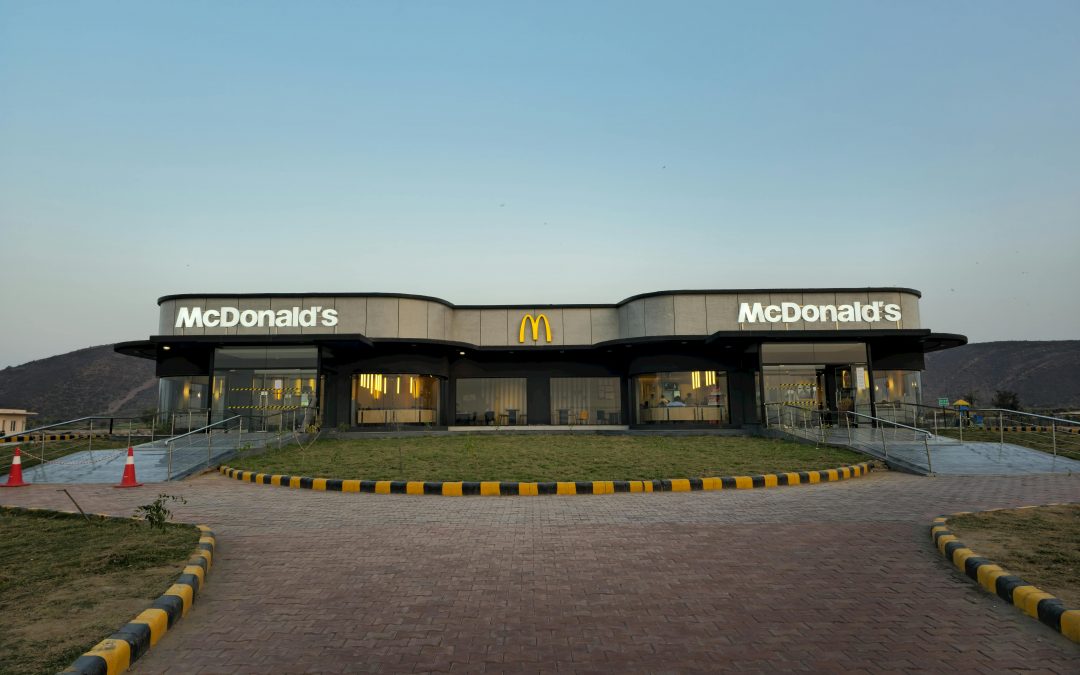
It’s not about the burger. It’s never been about the burger. McDonald’s built the most influential commercial real estate empire in the world and built a restaurant around it.
In my previous piece about traveling through the small towns of southern Spain, I wrote about the striking absence of global brands in the historic cores, where the butcher, the baker, and the family-run café all thrived in a walkable, human-scaled environment. “These weren’t tourist attractions; they were useful, everyday parts of life,” I wrote then, and that observation has stayed with me. But that first article told only half the story.
As soon as you step outside those old town walls, or as soon as you land back in the United States, the contrast becomes impossible to ignore. The brands missing from the medieval streets of Andalucía reappear instantly along the modern perimeters: McDonald’s, Burger King, Popeyes, Starbucks. And in America, they don’t just reappear; they define the commercial landscape.
Which brings me to McDonald’s, the brand that most clearly represents the other end of the spectrum from the Spain I described. If Spain taught me about the power of density and localism, McDonald’s teaches us about the power of consistency, infrastructure, and scale.
Freeways Built the World McDonald’s Dominates
One of the biggest misconceptions about American retail is that small towns are filled with strip malls. They’re not. Most American towns don’t have strip malls at all. What they have instead is something different: a freeway-driven commercial corridor, a linear retail spine shaped entirely by auto-oriented planning.
In Spain, towns were built around plazas. In America, towns were built around highways. McDonald’s mastered that geography better than anyone.
A McDonald’s at an interchange is more than a restaurant. It’s a signal. A marker of commercial viability. A gravitational anchor for complementary tenants. A zoning indicator. I’ve repeatedly seen this pattern across development projects: once a national anchor commits, the entire corridor’s economics shift.
In the Spain article, I described how “The towns weren’t fighting sprawl. They were built on the opposite principle: density of life, not density of parking.” By contrast, McDonald’s built an empire on parking density and turned it into a global advantage.
McDonald’s: The Real Estate Company That Happens to Serve Food
McDonald’s is often called the world’s biggest restaurant chain. More accurately, it is the world’s largest real estate company that also serves food.
This isn’t a clever reframing; it’s the truth. McDonald’s owns or controls the land beneath most of its franchised locations worldwide. Franchisees pay McDonald’s rent for the site and royalties for the brand. In the 1950s, Harry Sonneborn, one of the company’s earliest executives, put it plainly: McDonald’s isn’t in the hamburger business. It’s in the real estate business.
Ray Kroc understood that location control was the only way to ensure consistency, and that consistency was the only way to build trust at scale.
Consistency as an Emotional Product
What McDonald’s has truly mastered, and what most brands never will, is turning consistency into trust and trust into something close to emotional loyalty.
In Spain, emotional loyalty stems from familiarity with the local operator. In America, emotional loyalty stems from familiarity with the brand.
Walk into a McDonald’s anywhere in the world, and you already know the room’s temperature, the menu, the fries, and the process. For a traveler navigating an unfamiliar place, a family on a long drive, or someone on a tight budget, that predictability isn’t a limitation. It’s comforting.
McDonald’s recognized early that reliability is an emotional connection, and they built a global system to deliver it.
The Franchise Model: Local Accountability, Global Standards
By placing local operators in charge of individual restaurants, people with real financial stakes in their communities, McDonald’s gains the benefits of local ownership without sacrificing brand control. It’s one of the most elegant business models ever created.
The franchisor sets the standards. The franchisee implements them with the urgency of an owner. The customer experiences the same thing everywhere.
Spain’s independents do this too, just with a different soul and a different scale.
What Spain Revealed, and What McDonald’s Perfected
The Spain article showed me what American towns often lack: density, walkability, mixed-use, and the physical environment that allows independents to thrive. But it also showed me something else: American brands have become some of the world’s most successful exports, precisely because they were built for the modern, car-oriented, convenience-driven lifestyle that now exists globally.
Spain’s historic centers exemplify one model of commerce. McDonald’s exemplifies another. Both are powerful. Both are durable. Both tell the truth about the environments that created them.
The Real Lesson for Developers
I’m not arguing that McDonald’s is the ideal model for American commercial real estate. But it earned its ubiquity. It solved hard problems in real estate, operations, brand consistency, and franchising with a sophistication most companies never achieve.
For those of us who develop and manage commercial space, the lesson isn’t to imitate McDonald’s but to understand what it mastered:
- Infrastructure shapes commerce more than tenant mix
- Consistency beats novelty
- Location control beats marketing
- Freeways created a retail world where national brands thrive
- Walkability creates a retail world where independents thrive
The most interesting real estate being developed today is trying to combine both ideas in the same building: the reliability of a national brand and the authenticity of a local operator.
That’s the future worth building toward.