
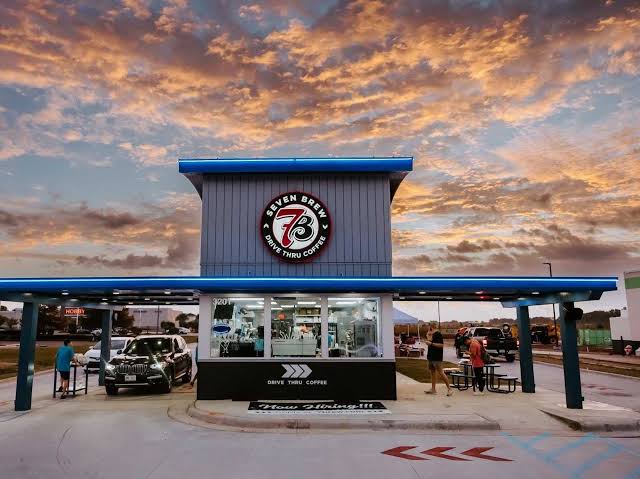
A few months ago in Roseville, I drove past a 7 Brew stand and noticed nine cars lined up in the double lane even before I finished parking, prompting me to take a closer look. That sight stuck with me because, in nearly 30 years of developing and managing restaurant real estate, I’ve rarely seen a brand transform a 510-square-foot space into one of the most efficient retail locations nationwide. This led me to explore the details, revealing a masterclass in disciplined growth that every developer should study.
The Numbers Behind the Growth
Founded in Rogers, Arkansas, in 2017, 7 Brew began its franchising journey in 2020 and has experienced unprecedented growth in my career. Starting with just 14 stores at the beginning of 2022, it surpassed 40 locations within that year. The expansion accelerated rapidly, reaching 180 by the end of 2023, 321 by the close of 2024, and over 700 stands across 38 states by mid-2026.
That trajectory results in approximately 4,200 percent unit growth since early 2022. Having opened numerous restaurants over the years, I can confirm that this rapid pace isn’t accidental. It’s driven by a real estate model designed for quick expansion, combined with a franchise system that emphasizes disciplined scaling rather than just increasing square footage.
By the Numbers
| Founded | 2017, Rogers, Arkansas |
| Locations (mid-2026) | 700+ stands across 38 states |
| Growth since 2022 | ~4,200% unit growth |
| Average annual unit sales | $2.658 million (FY2025, full-year stores) |
| Top-performing store | $6.366 million in annual sales |
| Typical store footprint | ~510 square feet |
| Total investment range | Roughly $890,000–$2.3 million per FDD ranges cited across sources |
| Royalty fee | 4.5%–7% of gross sales, plus ~2% marketing |
To understand the average unit volume, 7 Brew’s $2.658 million per store stands out against roughly $1.9 million for Starbucks (about 16,944 locations domestically), $2.16 million for Dutch Bros, and $1.3 million for the emerging Black Rock Coffee. From my years of evaluating restaurant concepts, the long-term winners are rarely those with the largest stores; instead, they are brands that generate the highest sales per square foot. 7 Brew achieves this on a footprint about one-tenth the size of a typical coffeehouse, illustrating the design of its business model.
Investment and Franchise Structure
What stands out most about 7 Brew’s growth is that most of it comes from franchised locations rather than corporate-owned stores. At the start of 2025, the brand had 297 franchised outlets and finished the year with 578, while its corporate-owned stores remained almost unchanged. Nearly all new openings have been financed by franchisees, not the company itself. This aligns with my career focus: when the unit economics are favorable, operators seek you out, eliminating the need to actively recruit.
Institutional investors agree. Blackstone, which also supports Jersey Mike’s and Tropical Smoothie Cafe, made a growth investment in 7 Brew as Drink House divested its ownership. On the franchise side, Flynn Group, the world’s largest franchise operator with brands like Applebee’s, Pizza Hut, and Wendy’s, agreed to develop 160 units in 2025. Franchise Equity Partners acquired 7 Crew, a 50-unit operator and one of the brand’s largest franchisees, and aims to expand by about 200 locations. When top-tier operators are doubling their commitments, it indicates that the fundamental numbers are solid, not just a fleeting trend.
7 Brew has been strengthening its leadership team to align with its growth goals, recruiting leaders with extensive QSR operating and supply chain expertise. Many fast-expanding brands have faltered because their infrastructure didn’t scale with the number of their units. This brand appears to recognize the importance of professionalizing its operations before it expands too rapidly.
Outpacing the Competition
7 Brew now ranks alongside Dutch Bros and Scooter’s Coffee as the top three brands shaping the modern drive-thru coffee market. However, its growth rate is exceptional even among these leaders. Dutch Bros, with over 1,100 locations and plans to reach about 2,000 by 2029, remains the largest. Scooter’s has established a steady presence with more than 800 locations over several decades. What is remarkable is how quickly 7 Brew has closed the gap: starting with just 14 stores in early 2022, it is now nearing the size of brands that have been expanding for ten years or more.
Much of this hinges on real estate discipline. The approximately 510-square-foot prototype, modular build, and focus on double-lane drive-thru-only locations help keep development costs and site requirements low compared to traditional café models. I always tell my development team that the site mostly determines the economics, and 7 Brew has created a footprint that is profitable on outparcels, pad sites, and smaller infill lots, which larger competitors find challenging to match.
New Locations and New Formats
In 2025, 7 Brew surpassed 500 stores, achieving over 50% unit growth in just 10 months, up from 321 stores at the end of 2024. I monitored this milestone carefully because brands rarely sustain such rapid expansion without issues arising, whether in site quality, training, or franchisee support. Based on my observations, 7 Brew has maintained its standards despite opening locations at a pace that most of the industry would consider aggressive.
The brand has expanded into new formats, including its first walk-through location inside Walmart. This is a strategic move, as it creates a new development opportunity beyond the original standalone drive-thru model that established the brand. It also demonstrates a leadership team that isn’t resting on its laurels just because its current approach is successful.
The Drive-Thru Principle
To understand why 7 Brew succeeds, consider beyond the menu and focus on the lane setup. Each location features double drive-thru lanes that enable the “Brew Crew” to craft orders swiftly while maintaining the personal interaction between the order-taker and customer, which is a signature of the brand. This setup reflects both real estate and operational strategies, and I admire this approach.
The model is built on four pillars that the company openly discusses: friendly service based on a mission to “cultivate kindness”; speed facilitated by a double-lane format; extensive customization offering over 20,000 drink options, including sugar-free, caffeine-free, and alternative-milk choices; and value, characterized by bold flavors and generous portions at competitive prices against both traditional coffeehouses and newer competitors.
In my experience, the brands that win in this business are the ones where the physical site and the brand promise are the same thing, where you can’t separate the real estate from the experience. 7 Brew’s double-lane site is the brand. That alignment is rare, and it’s exactly why I think this concept has more room to run.
Why It Matters for Developers
Throughout my career, I’ve invested in real estate that maximizes every square foot, and 7 Brew clearly exemplifies this approach. Its average unit sales are comparable to or surpass those of much larger brands. Its compact footprint allows it to operate in locations unsuitable for larger formats, and its franchise pipelines, supported by experienced multi-unit operators such as Flynn Group and Franchise Equity Partners, indicate there is still significant room for growth.
Will 7 Brew face the same saturation pressures that have slowed other rapidly expanding chains? Possibly. Many brands have exhausted their growth potential after similar expansions. However, currently, this is one of the strongest examples I’ve seen in years of how careful real estate choices combined with a robust franchise model can elevate a regional drive-thru to a national level in less than ten years. It represents the type of growth story that influences our strategic considerations for future pipeline opportunities.